When Charles Dickens published “A Christmas Carol” in London 171 years ago on December 19, 1843, he was greeted with immediate success in almost every measurable way. The book’s first run of 6,000 copies sold out during the run-up to Christmas Eve, and critics hailed the book as a masterpiece. But in the financial arena, where Dickens had hoped the book would help ease the burden on his growing family (his wife was pregnant for the fifth time out of 10), things were different.
Despite being a bestseller, the book wasn’t the financial windfall its writer had hoped for. Some of the fault was Dickens’ own. He was so enamored of his story -- which he hoped would help revive some of Britain’s old Christmas traditions and spread a sense of social concern for the poor -- that he insisted it be printed on the fanciest material as befitting a gift book, with gold lettering on the spine and cover, gilded edges, and woodcuts. He was so picky that he insisted the book be reprinted when he saw the colors on the first run and deemed them too drab. All of this added to the costs of production, but the book was still sold at a price (the equivalent of about $33 a copy today) that made it accessible to more people, but failed to cover its expensive outlay while leaving many profits. Dickens was also plagued by piracy, which he went to court to fight. He won, but the rogue printer pleaded bankruptcy and Dickens was left to pay his own legal fees.
But if the book didn’t bring Dickens a lot of money, it achieved something more lasting. Dickens had originally thought about releasing a pamphlet pleading for Britons to do more for the poor who had been displaced by the Industrial Revolution, but he decided that pouring himself into an earnest and nostalgic Christmas tale might have more impact. Within a year of its publication, at least eight theaters in London were staging productions of “Carol.” Dickens himself was asked to do public readings of the book, which he did…more than 120 of them before he died in 1870.
The book has never gone out of print, and its impact on the Christmas season goes well beyond its memorable characters and phrases. It’s been argued that many of the trappings of Western Christmas celebrations can be attributed at least partially to Dickens’ story, which emerged at a time when Britons were exploring some of their older traditions in an attempt to revive the holiday. It has been adapted into countless media forms, including at least 28 movies. Sternly dramatic retellings, musicals, a silent film from 1901, a modernized Bill Murray fable, Mickey Mouse, and the Muppets…all of them have been brought into the service of “A Christmas Carol.”
As for its impact on public charity and benevolence, one critic said it had inspired more generosity than “all the pulpits and confessionals in Christendom." (High praise, given that Dickens had written the book as a kind of Christian allegory. His description of Jacob Marley as having no bowels was a reference to the “bowels of compassion” mentioned in I John.) Stories abound of people being moved to generosity by Scrooge’s tale of redemption. The writer Thomas Carlyle supposedly staged two Christmas dinners after reading it. In 1867, a businessman in Massachusetts is said to have closed his factory on Christmas Day and sent every employee a turkey after attending a reading the night before. And the Queen of Norway sent gifts to London’s crippled children in the early 20th century marked “with Tiny Tim’s Love.”
Much like his protagonist Scrooge, Dickens seems to have overseen a bounty of gifts more valuable than anything a money ledger could tabulate. It’s rare that a book has exactly its intended effect, but with “Carol,” Dickens not only affected his readers while they turned its pages, but he impacted how they lived their lives. Whatever financial blessings the story brought him, Charles Dickens blessed us (every one) with his enduring carol.
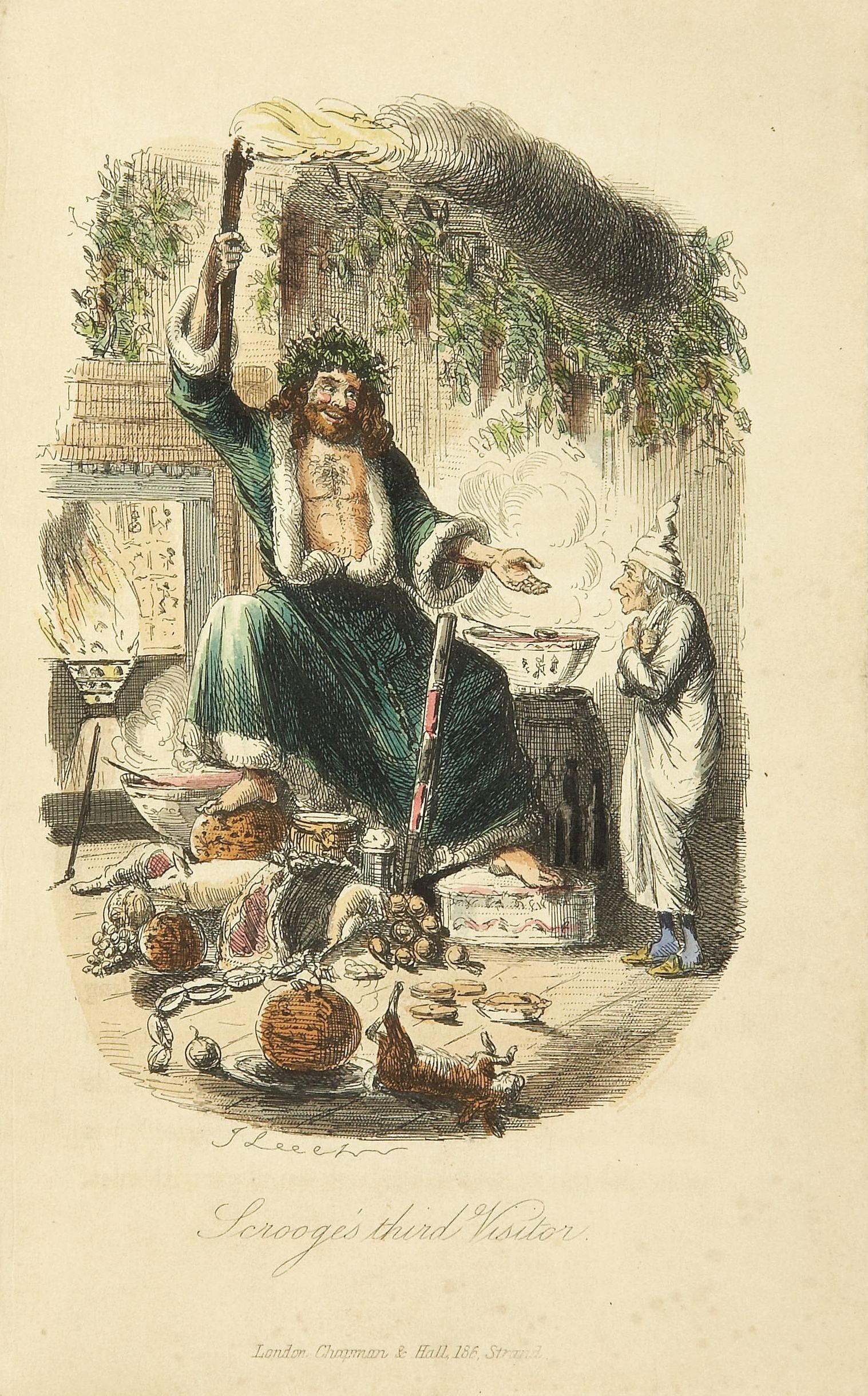 |
| http://upload.wikimedia.org/wikipedia/commons/c/c1/Scrooges_third_visitor-John_Leech,1843.jpg |

No comments:
Post a Comment