The opening line states “’Twas the night before Christmas,” but it was actually a day early when the famous poem was published anonymously in Troy, N.Y.’s Sentinel newspaper 191 years ago on December 23, 1823.
We know now that the poem, titled “A Visit From St. Nicholas” on publication, was most likely penned by Clement Clarke Moore, but it took years for him to be identified as the author in 1837. For 14 years, the poem was anonymous. It’s perhaps better off that way, because Moore is a complex character who could only be produced by a certain time in American history. A Northerner and a seminary professor who taught Eastern literature and the Bible, he was also a slaveholder who opposed abolition and a polemicist who penned harsh political attacks on Thomas Jefferson based on his religion. Maybe he sensed that his little poem was best left untangled from all of that. More likely, he just thought the simple verses weren’t fitting for the resume of a serious scholar like himself.
Regardless of that, Moore’s poem is the reason he is remembered at all…and it has defined a central part of our Christmas tradition in this country. Before “’Twas the Night…” came along, the imported European tradition of St. Nicholas was, like a bowlful of jelly, hard to nail down in its stateside form. The fur-clad saint, known as Sinterklaas by the Dutch, was a mysterious fellow. He gave gifts secretly, but people were free to imagine him any way they wanted.
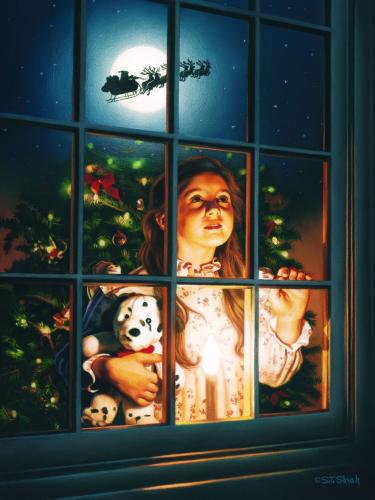
Moore nailed down that tradition, and many parts of his interpretation have clung to St. Nick like ashes and soot ever since. A white-bearded jolly fellow, with a round belly, who comes down the chimney on Christmas Eve, with a bag full of toys, then takes off in a sleigh pulled by eight reindeer: Every word of that description is straight from Moore.
What’s also interesting is which parts of Moore’s vision didn’t stick. Moore’s text is clear that his St. Nick is not a large fellow. “Miniature sleigh,” “tiny reindeer,” “jolly old elf”…these descriptions explain why it would be easy for Moore’s saint to fit down a chimney, but they’re overlooked in a culture that doesn’t do anything small. St. Nick’s heavy smoking (to the point that smoke encircles his head like a wreath) has also been toned down, which is probably a good thing, since he’d be fined for lighting up publicly in most parts of the country these days.
The “death of the author” phenomenon says that a writer’s intention is far less important than what readers see in a work. And while readers have been selective in what they’ve retained from Moore’s story and attached to our Santa Claus, what they have retained has been remarkably consistent and durable. Moore’s verses have been called the most famous in American writing. Tomorrow night, countless kids will be on edge because of the yarn he wove. For a holiday that had been centered around a hectic and harried Christmas Day, Moore injected quiet anticipation into the night before. He populated one night of the year with magic which hasn’t faded yet. Whatever else he may have done in his life, that’s not a bad legacy at all.
 |
| http://studentweb.cortland.edu/Karen.Jordan/finalproject/looking%20%20out%20window.jpg |

No comments:
Post a Comment