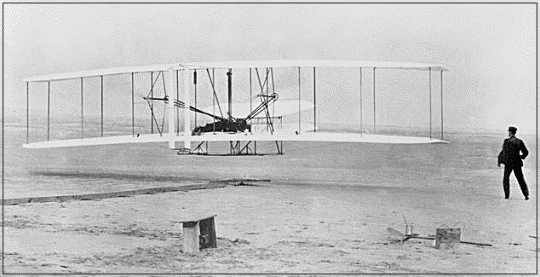
Aviation milestones are a favorite here at AWC, and today’s soars above them all. The handful of witnesses who gathered at Kitty Hawk on North Carolina’s Outer Banks 111 years ago on December 17, 1903, couldn’t have known they were witnessing the final day of an age that had lasted from the dawn of humanity…an age where men looked at birds with jealousy and longing, and where the sky really was the limit.
The successful flights of Orville and Wilbur Wright’s “Wright Flyer” that day is often shorthanded as the first airplane flight, but aviation authorities are more specific. To be precise, the Wright Brothers’ machine was the first to successfully achieve four conditions in flight: It was heavier than air, self-propelled, controlled, and its flight was sustained. The brothers had made many successful glider flights before graduating to the gasoline-powered wooden biplane that took to the air on this date. Their last successful glider in 1902 led directly to the design of the fateful flyer the following year.
The brothers had already attempted a flight three days earlier, but Wilbur had pulled up too sharply and crashed within three seconds, damaging the plane. They spent three days repairing it, and on this date Orville took his chance to go first and took the controls. He flew for 12 seconds, and traveled 120 feet. They took turns from there, and Wilbur redeemed himself by traveling 852 feet in 59 seconds on the day's last flight. The aviation age had arrived.
It wasn’t a noisy arrival. Only a handful of newspapers covered the story the next day. Many editors either didn’t believe it, or didn’t understand it. The brothers took advantage of their prolonged anonymity, since they had patents to file, work that was much easier when the world didn’t realize what they were up to. Many people assumed they hadn’t flown at all. They were called liars until their first public flight in France in 1908.
After that, they were genuine celebrities. They were two brothers from Dayton, Ohio, who never graduated high school, never went to college, and started their careers working together at a printing press and a bicycle shop, and they might have been the 20th century’s most significant figures. Wilbur, who was four years older, would only glimpse the beginnings of the change they unleashed. He died in 1912 at age 45 while suffering from typhoid fever. Orville got to see more, living until 1948. When he was born in 1871, the horse-and-buggy had been in common use. By the time he died at age 76, the jet engine had arrived and airplanes had broken the sound barrier.
 |
| http://www.wpclipart.com/world_history/the_hand_of_man/wright_brothers_first_flight_1903.png |

No comments:
Post a Comment