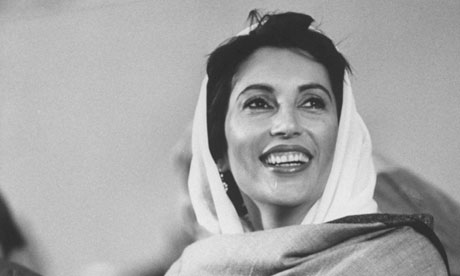
Benazir Bhutto became the first female leader of a majority Muslim country 26 years ago, winning election as Pakistan’s Prime Minister on November 16, 1988. She served two nonconsecutive terms from 1988-1990, and again from 1993-1996. Like many politicians, her legacy is complicated. Allegations of corruption (including nuclear deals with North Korea) hounded her throughout her life, contributing to the fall of her first government in 1990.
But she was also a clear-eyed reformer, who advanced the causes of democracy and modernization (critics said “Westernization”) in the Islamic world…stances that brought her peril, both political and personal. She stood with the United States against Communism at the end of the Cold War, but recognized that both East and West were overlooking dangers grown in her own part of the world. She saw that America’s anti-Soviet mood had brought it in league with anti-Communist Afghan fighters like Osama Bin Laden, and prophetically told the first President Bush that anti-Soviet policies were “creating a Frankenstein” in Afghanistan.
She was assassinated in December 2007, while campaigning for another term in Pakistan’s Parliament. While she has been criticized for not doing enough to advance the cause of women while she was in power, the simple fact that she was elected at all spoke volumes in a part of the world often seen as anti-modern. Today, women fully participate in Pakistani politics and elections, and many of them no doubt do it with the memory of Benazir Bhutto.
 |
| http://static.guim.co.uk/sys-images/Guardian/Pix/pictures/2013/9/24/1380031730904/Benazir-Bhutto-006.jpg |

No comments:
Post a Comment