To be fair, it’s a bit of a miracle that the OED got published at all. What had started as an idea by three friends to plug some holes in the available dictionaries by publishing English words that hadn’t been covered before turned into an undertaking almost breathtaking in its scope…a comprehensive English dictionary, listing every word in the history of the language, stretching back to the medieval Anglo-Saxons. To pull this off, they needed an army of volunteers to read and copy usages of the words onto quotation slips. Naturally, these people brought different standards of scholarly judgment and clerical skills to the work. Many of the slips were lost. One of the most prolific readers was confined to an asylum for the criminally insane after killing a man.
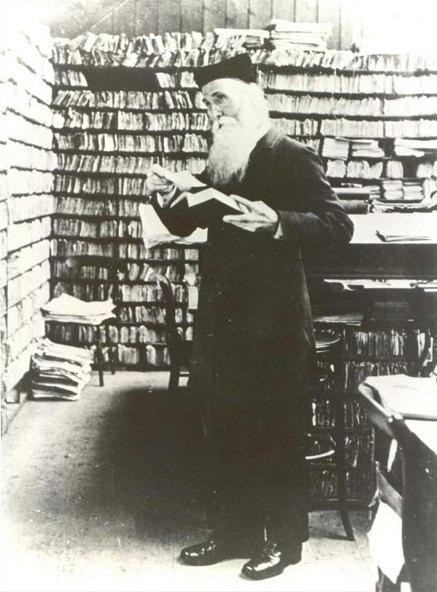
In short, it was a logistical nightmare. And still various editors soldiered on (including the first editor, James Murray, seen here at work in his “Scriptorium"). Murray and others shepherded the first 352-page installment (“A to Ant”) to publication on this date in 1884, then continued with the ensuing installments until the first edition was completed in 1928. The first installment carried the ungainly name “A New English Dictionary on Historical Principles; Founded Mainly on the Materials Collected by The Philological Society.” By 1895 it had become the Oxford English Dictionary.
Supplements were released for the first edition, until it became clear that a second edition was needed to combine all the materials and update the text for the computer age. The second edition of the OED came out in 1989. It contained 20 bound volumes, twice as many as the first edition, and needed 120 keyboarders using specialized software to enter it all. The ‘80s also saw the OED released on CD-ROM for those who wanted to look up a word, but didn’t have the shelf space for a printed version. A third edition has been in the works since 2000, although it will probably never be printed. The full revision is expected to be finished by 2037, and will live online…or whatever the equivalent is by that time.
The OED has become the definitive English dictionary for many people, and its comprehensiveness is a major reason for that judgment. By 2005, combining all of the OED’s main entries with its derivatives, compounds, phrases, and other word forms yielded over 616,000 entries. It’s been estimated that one person would need 120 years to type out the full text – 59 million words – of the second edition. And thanks to yearly updates, the dusty old OED can still tell you exactly what a selfie is.
 |
| http://upload.wikimedia.org/wikipedia/commons/a/ac/James-Murray.jpg |

No comments:
Post a Comment