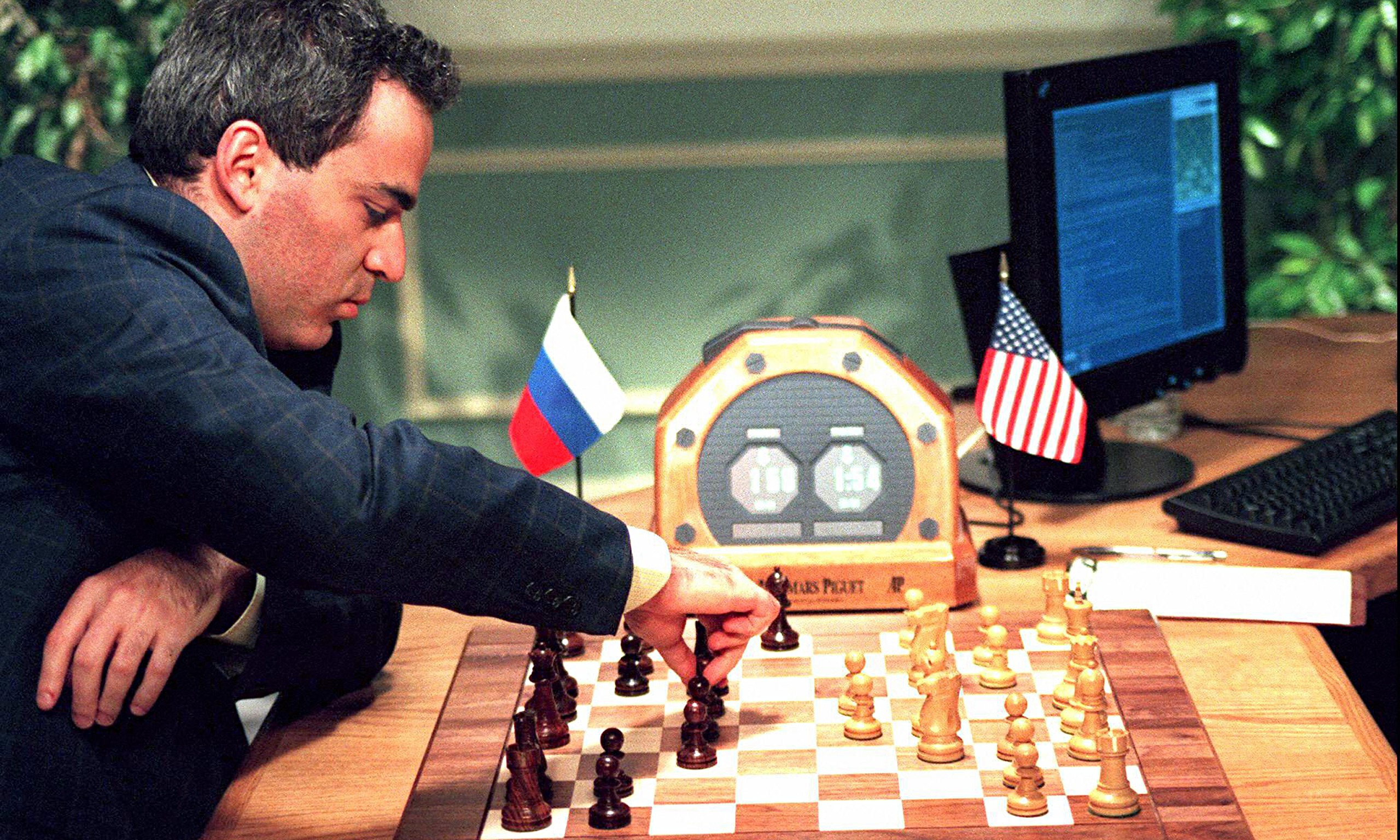
In fairness to our future robot overlords, AWC should note that an upgraded Deep Blue won a rematch against Kasparov the following year. But maybe that just enhances the impressiveness of Kasparov’s first win. Kasparov suspected IBM of cheating in the 1997 rematch by using human chess players to intervene between moves. (The rules only allowed humans to move Deep Blue’s pieces and reprogram “him” between games.) Kasparov asked for a third match, but IBM declined and retired Deep Blue. It’s possible Kasparov fell victim to the human tendency to see patterns in randomness. A random move by Deep Blue due to a bug spooked Kasparov during one game, making him think he was matched against a creative intelligence, instead of a brute force calculating machine. In all, Kasparov and Deep Blue played 12 games over the two matches, with Kasparov winning 4, Deep Blue taking 3, and 5 ending in draws.
A tale of the tape reveals that in the machine corner, Deep Blue was able to evaluate 200 million positions per second. That proved just enough to keep up with Kasparov out of the human corner, a Russian who became the world’s youngest undisputed chess champion at age 22.
Chess-playing computers have become passé since the 1990's, with developers focusing on chess software programs like Deep Junior over hardware specifically dedicated to the task. IBM would go on to develop Watson, a computer who went on “Jeopardy!” in 2011 and crushed the uber-champ Ken Jennings, who declared in his Final Jeopardy response “I for one welcome our new computer overlords.” He later wrote “'Quiz show contestant' may be the first job made redundant by Watson, but I'm sure it won't be the last.”
As for Kasparov, he retired from chess in 2005. He has spent his time trying to crack the door into Russian politics, but has found opposing Vladimir Putin to be far more confounding than putting Deep Blue in checkmate ever was. He currently sits on the board of directors for the Human Rights Foundation, a fitting spot for a guy who struck a small blow for humanity against technology on this date.

No comments:
Post a Comment