If it seems like Laura Ingalls Wilder (born 148 years ago on February 7, 1867) couldn’t keep all the details of her childhood on the move straight, it’s easy to sympathize. By the time she was 12, the daughter of a restless farmer and would-be businessman had experienced the following sequence in an itinerant childhood: Leaving the Big Woods of western Wisconsin in 1869, with a stop in Missouri en route to Kansas Indian Country; back to the Big Woods in 1871; on to Walnut Grove, Minnesota in 1874; down to Burr Oak, Iowa, to help run a hotel around 1877; back to Walnut Grove, where her father Charles served as town butcher and justice of the peace; and finally into the eastern Dakota territory, where Charles had taken a railroad job in 1879. There, in De Smet, South Dakota, the family finally settled.
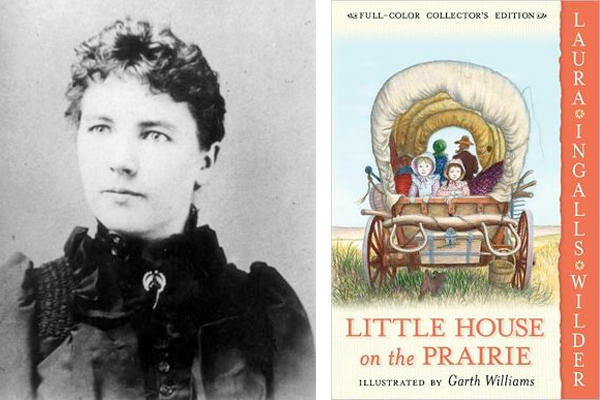
Writing about these events later, Wilder would switch around some events and leave others out completely (like the hotel in Iowa). This was likely to help move the story along more easily, and possibly to satisfy her publisher, who supposedly thought her real-life memories of Kansas were too vivid for a 3-year-old, and asked her to make the pseudo-fictional Laura Ingalls a bit older when the family arrived in Kansas and built a “Little House on the Prairie.”
While the Ingalls family planted their stakes in South Dakota, Laura herself kept moving. After becoming a teenage schoolteacher, she married Almonzo Wilder in 1885, when she was 18. The Wilders left South Dakota; briefly spent time with Almonzo’s parents in Minnesota; tried life in Florida, hoping the climate would help Almonzo’s health (he had been partially paralyzed by diphtheria); and finally settled down in Mansfield, Missouri in 1894, where they would both live out their days.
It was in Missouri that Laura became a local columnist and polished her writing skills. Her daughter Rose, who was already a successful writer, encouraged her mother to follow the same path. Finally, after the Great Depression wiped out the Wilders, Laura decided to give writing a try. Her mother and older sister had died, and she believed it was time to preserve her childhood memories in writing. In 1932, she published “Little House in the Big Woods,” the first in an eight-volume series. The “Little House” books served their purpose: Laura preserved her memories, and she and Almonzo made enough money from the series to live comfortably on their Missouri farm until his death at age 92 in 1949, and hers eight years later at 89. They are buried together at the Mansfield cemetery.
The “Little House” books have been subject to a minor controversy over their primary authorship, with some suggestion that Rose was the true author, taking her mother’s rough manuscripts and polishing them until they were suitable for publishing. While the women maintained a lengthy correspondence over the works, the truth is impossible to tell from the record. Regardless of how we got them, the stories of Laura Ingalls Wilder’s childhood have fascinated generations, never going out of print and inspiring a TV show that ran from 1974-83. A replica of Laura’s childhood cabin, called the Little House Wayside, stands in Pepin County, Wisconsin. It’s a tribute to the beginnings of a life filled with movement and hardship, and marked by optimism that home was just over the next horizon…perhaps one of the most American lives ever lived.
Writing about these events later, Wilder would switch around some events and leave others out completely (like the hotel in Iowa). This was likely to help move the story along more easily, and possibly to satisfy her publisher, who supposedly thought her real-life memories of Kansas were too vivid for a 3-year-old, and asked her to make the pseudo-fictional Laura Ingalls a bit older when the family arrived in Kansas and built a “Little House on the Prairie.”
While the Ingalls family planted their stakes in South Dakota, Laura herself kept moving. After becoming a teenage schoolteacher, she married Almonzo Wilder in 1885, when she was 18. The Wilders left South Dakota; briefly spent time with Almonzo’s parents in Minnesota; tried life in Florida, hoping the climate would help Almonzo’s health (he had been partially paralyzed by diphtheria); and finally settled down in Mansfield, Missouri in 1894, where they would both live out their days.
It was in Missouri that Laura became a local columnist and polished her writing skills. Her daughter Rose, who was already a successful writer, encouraged her mother to follow the same path. Finally, after the Great Depression wiped out the Wilders, Laura decided to give writing a try. Her mother and older sister had died, and she believed it was time to preserve her childhood memories in writing. In 1932, she published “Little House in the Big Woods,” the first in an eight-volume series. The “Little House” books served their purpose: Laura preserved her memories, and she and Almonzo made enough money from the series to live comfortably on their Missouri farm until his death at age 92 in 1949, and hers eight years later at 89. They are buried together at the Mansfield cemetery.
The “Little House” books have been subject to a minor controversy over their primary authorship, with some suggestion that Rose was the true author, taking her mother’s rough manuscripts and polishing them until they were suitable for publishing. While the women maintained a lengthy correspondence over the works, the truth is impossible to tell from the record. Regardless of how we got them, the stories of Laura Ingalls Wilder’s childhood have fascinated generations, never going out of print and inspiring a TV show that ran from 1974-83. A replica of Laura’s childhood cabin, called the Little House Wayside, stands in Pepin County, Wisconsin. It’s a tribute to the beginnings of a life filled with movement and hardship, and marked by optimism that home was just over the next horizon…perhaps one of the most American lives ever lived.
 |
| https://latebloomersrule.files.wordpress.com/2013/06/laura-ingalls-wilder.jpg |

No comments:
Post a Comment