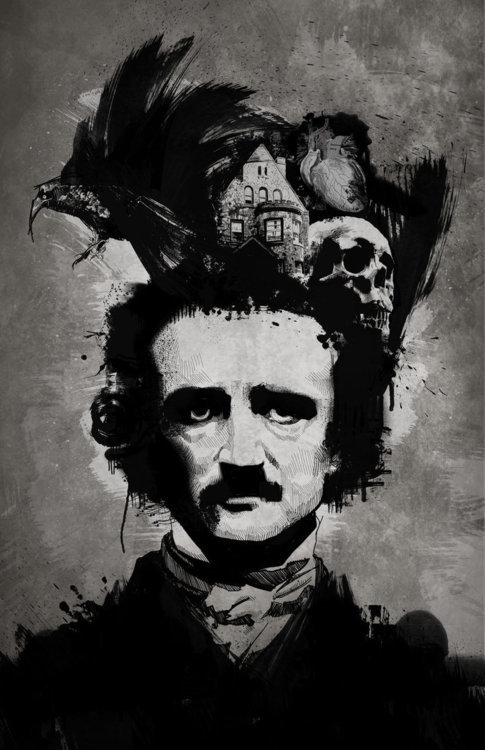
The work of Edgar Allan Poe (born 206 years ago in Boston on January 19, 1809) might give the impression of a life lived among crypts and séances, but the true fear that stalked him on earth was more banal, if just as frightening: Money, specifically the lack of it.
Poe made a bold decision to support himself through writing alone, the first great American writer to try that route. It would be tough for anyone, but he picked a particularly awful time for it. Before international copyright restrictions took hold, American publishers were happy to steal British literature instead of paying homegrown writers. The Panic of 1837 also sank the American economy, meaning even writers who could get work often went unpaid. Throughout his short life, Poe found himself repeatedly reduced to little better than begging, as his list of debts grew longer.
After years of writing (his first book was published in 1827), he finally achieved his popular breakthrough in 1845, when “The Raven” was published in the New York Evening Mirror. It was an instant hit, and made Poe a household name. He got $9 from it. The following year, the journal he owned and edited failed. The year after that, his wife Virginia died of tuberculosis. Suitably humbled by life, Poe died just two years after his wife in 1849. The story of his death is fittingly mysterious and has spawned many theories: The 40-year-old Poe was spotted walking around Baltimore, spouting delirious phrases and wearing clothes that weren’t his own. He died in the hospital four days later. No medical records, including his death certificate, have survived.
Here are some of the theories that have been presented for Poe’s cause of death: Alcohol, drugs, delirium tremens, tuberculosis, heart disease, epilepsy, syphilis, meningeal inflammation, cholera and rabies. Maybe the most sinister possibility is that Poe died from the practice of cooping. This was a nasty bit of 19th-century corruption where citizens were kidnapped and forced to vote for the same candidate in an election over and over. They were often plied with alcohol, forced to change clothes to avoid detection, and sometimes beaten or killed if they didn’t cooperate.
Whatever the truth, it’s clear that Poe’s life and death were, in their own way, as dark as the stories and poems he left behind…material that became popular in Europe first, before eventually becoming appreciated in his home country. “The Murders in the Rue Morgue,” “The Pit and the Pendulum,” “The Tell-Tale Heart,” and “The Masque of the Red Death” are among the creepy tales that still tingle spines. In addition to his dark Gothic works, he was also revered later as a pioneer in detective fiction and science fiction. Arthur Conan Doyle, Jules Verne, and H.G. Wells all explicitly credited him as an inspiration. Ironically for someone who struggled so mightily to make a dollar, Poe’s first book sold at auction for more than $660,000 in 2009…the highest price ever fetched for an American work. He might have died with nothing to his name, but Edgar Allan Poe left a rich library of the macabre that promises to thrill readers forevermore.
 |
| http://ekladata.com/fWqi4ThlmRxzOBiZ0oGeQcaYdqE.jpg |

No comments:
Post a Comment