Our eternal quest to go farther and faster got two big bumps on this date, thanks to a pair of breakthroughs in human travel. The USS Nautilus, the world’s first nuclear-powered submarine, was launched in Connecticut 61 years ago on January 21, 1954. Twenty-two years later, Concorde became the first supersonic jet to offer passenger service on January 21, 1976.
The Nautilus was named after Jules Verne’s fictional vessel in “Twenty Thousand Leagues Under the Sea,” and was the fourth U.S. Navy vessel to bear the name. But this Nautilus would actually earn its comparison to Capt. Nemo’s legendary craft, thanks to a nuclear-powered propulsion system that allowed her to operate free of surface-level oxygen. The Nautilus could stay submerged indefinitely as a result, recycling breathing air and distilling seawater into fresh water. The only limit on her ability to stay underwater was the amount of food on board. She completed a record-breaking trip to the North Pole in 1958, and logged over 300,000 nautical miles (her fictional counterpart only claimed 60,000) before being decommissioned in 1980.
Two decades after the Nautilus blazed trails underseas, Concorde did the same in the skies. A joint Anglo-French project, Concorde wasn’t the first supersonic transport developed. (That would be the Soviet Tupolev.) But it was the first to begin ferrying passengers through the air at almost unimaginable speeds. On this date in 1976, two Concorde turbojet-powered airliners entered passenger service. One served the route between London and Bahrain, while the other offered transatlantic service between Paris and Rio. (The US market was off limits at first, since Congress had outlawed supersonic landings due to noise complaints over the sonic booms generated.) When that ban ended in 1977, Concorde began service from London and Paris to New York.
Concorde had a top speed of Mach 2.04 (over twice the speed of sound), and was capable of covering the route between New York and London in under three hours on a good day. Concorde became a staple of the jet set, a symbol of travel for the rich and famous. French and British heads of state used it frequently, and the Pope logged a flight in 1989. But it was always more of a symbol than a commercial hit, and only 20 were ever built. (Six of those were prototypes.) Following a deadly crash in 2000 that killed 113 people (the only fatal accident in Concorde’s history) and the general downturn in aviation following 9/11, Concorde’s glory days were over. Air France and British Airways both discontinued their Concorde routes in 2003.
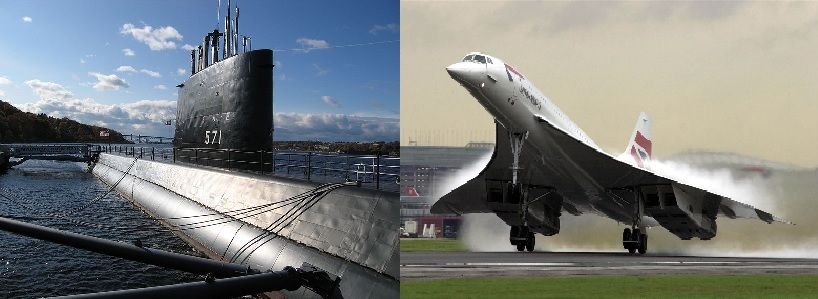 |
| Photo montage assembled by AWC |

No comments:
Post a Comment