Saturday, March 7, 2015

A final Anniversary Worth Celebrating, and I can’t think of a better one. A year ago, I was a Georgia-to-California transplant trying to balance school, work, and the ever-tricky third space where human connections are supposed to happen. Combining all of this, I paradoxically had too little free time, and too much. If I had thought too much about it, I might have never asked out a girl who was a year ahead of me in my graduate program. The demands of a working student’s life could have easily paralyzed any attempt to add more.
But, you guys…seriously. She could talk about best practices in multi-tiered school service delivery models, and actually make you listen. She had a laugh and a smile I couldn’t stop thinking about (and I spent a few days trying). So I went for it. I pulled out every bad joke I could think of to ask her out. She wasn’t scared away.
And so, one year ago on March 7, 2014, I picked up Sarah and we drove off into the murky mists of Getting to Know Each Other. Statistically speaking, it wasn’t likely to work. (Most first dates are monuments to unwarranted optimism.) We went to Disneyland, which is setting the bar pretty damn high out of the gate anyway. If this actually worked, what was I supposed to do for an encore? With no justification, I scared her on the Haunted Mansion. With full justification, she punched me in the arm. And I knew she had some fight, and I knew there was more to find out.
I asked her out a second time. She made me wait three days for a reply. (She claims she was busy. I’m still not sure.) But friends, when my entreaty for a repeat engagement was granted, no bard of old ever saw the clouds part so beautifully. (I still smile walking past the campus fountain where I read her reply.)
One year from that fateful evening at Disneyland, I’ve learned a lot more about Mexican food (the real kind), and she’s heard a lot more bad jokes. I didn’t have time for this. Neither did she. But we found a year, and counting.
I didn’t plan this anniversary right at the end of my little anniversary series. (That would have been a little weird.) It just worked out that way. But it’s a great reminder that Anniversaries Worth Celebrating don’t have to just live in history books. New Anniversaries Worth Celebrating can happen anytime. Go out and make some.

Friday, March 6, 2015

AWC is going meta today, celebrating the anniversary of...celebrating anniversaries. Forgive the self-indulgence, but it was two years ago that this series took its first trembling steps on March 6, 2013. The first post was an ode to the humble Oreo, which Nabisco claims to have developed at its factory in Manhattan’s Chelsea neighborhood on this date 103 years ago on March 6, 1912. The Oreo was actually an imitation of the older Hydrox cookie, but after its introduction a funny thing happened. Nabisco did such a good job copying Hydrox that they ended up making a better cookie, and Hydrox came to be seen as the cheap knockoff.
If you’re celebrating a birthday or anniversary, Oreos aren’t a bad choice to have on hand. You can make a cake with them, or skip the middleman and just try the Birthday Cake flavored variants, one of dozens of flavors Nabisco has introduced over the years. (Others have included Red Velvet, Pumpkin Spice, Peanut Butter, Gingerbread, and Watermelon, because sure, why not?)
Since starting with cookies, this series has spent two years traveling far and wide to find anniversaries worth celebrating. (Your humble correspondent took a year-long break starting on June 2, 2013 and picked up right where we left off on the same date last summer.) In that time, we’ve covered everything from sliced bread to Superman. We’ve gone from the banks of the Halys River in modern-day Turkey in 585 BC (the earliest date on our anniversary quest) to the steps of the U.S. Supreme Court in 2013 (the most recent). The 1960s seemed to be AWC’s favorite decade. With its mix of milestones in civil rights and space exploration, along with great music, pro football, and heart surgery, the ‘60s accounted for 34 posts – nearly one in 10 of the total.
Recurring characters on our journey included Abraham Lincoln, Teddy Roosevelt, Thomas Edison, Albert Einstein, Walt Disney, and Elvis Presley. And then there was baseball, a game with a past that makes it irresistible as a prism for history. It showed up at least 17 times in posts that ranged from on-field achievements, to the Hall of Fame in Cooperstown, to “Casey at the Bat.” All of these choices reflect the biases of one person, namely me. But hopefully in a year’s worth of milestones in sports, entertainment, politics, science, and whatever weird stories grabbed my fancy, you found more than a few items to brighten up your day. This series had one simple goal from the beginning: Find something that a person of good will could celebrate on every day of the year. I think we succeeded.
If it sounds like we’re about to turn out the lights on AWC, that’s true. But there’s still one more piece of business to tend to before we lock the doors. Tune in tomorrow…
http://static7.businessinsider.com/image/4f514a78eab8eac10b000091/oreo-bday.jpg

Thursday, March 5, 2015

AWC is wrapping up its trip around the calendar with a tale of the American frontier, where life was tough 180 years ago. With no 911 service, isolated homesteaders had to defend their own territory. A hunting rifle could serve as a defensive weapon in a pinch, but the time needed to reload between shots meant you’d better aim well the first time. But Samuel Colt started a revolution in the firearms industry when he formed the Patent Arms Manufacturing company and made the first production model of the .34 caliber revolver on the same day 179 years ago on March 5, 1836. While Colt didn’t invent the revolver, he would go on to popularize it.

Handguns are bound to trigger controversy as a topic of celebration, and in an urbanized country with an established police force, a case can be made that wide access to firearms does more harm than good. But things were different in 1836, particularly west of the Mississippi. Families often had to fend for themselves, and a reliable gun was a fact of life. With the Colt revolver (Colt’s patent gave him exclusive production rights until 1857), a major shortcoming of the rifle and single-shot pistol was overcome. The revolving chamber allowed the trigger action to slide the next bullet into place, allowing the gunman (or woman) to get off the next round by just cocking the hammer and firing again.

With the ability to get off multiple shots at once from a compact weapon that traveled in a holster, settlers stood better odds against cattle thieves or Indian raids. The six-shooter could also be used for hunting, although the short barrel and lack of a sight made it less suitable than a hunting rifle for taking down game. (Colt’s company seemed to realize the value of the rifle-handgun combo. The Colt Frontier Six-Shooter was released in 1877, and was designed to be compatible with the same .44-40 caliber bullets used in the popular Winchester rifle, allowing settlers to carry one type of ammunition for both guns.)

The downside of this story is that the phrase “arms race” exists for a reason. If the good guys have better weapons, it’s a matter of seconds until the bad guys have them too. Colt’s handguns were popular with criminals as well as ranchers, and with Native Americans as well as cowboys. (Who qualified as the good guys or the bad guys in that scenario is still being debated.) It’s fair to say that Colt was probably a mercenary, who didn’t particularly care where his weapons ended up. (He approached both North and South to do business during the Civil War, and was said to believe that even bad publicity was fine, as long as his guns were referenced by name.)

But in lawless frontier towns where everyone carried, the revolver was seen as largely a force for good. One popular adage said that “God made men, but Samuel Colt made them equal.” (Of course, that could have been some of Colt’s famous marketing.) The Colt Single Action Army model was coined “the Peacemaker,” and is so iconic that it’s become known as “the gun that won the West.” (That’s not just marketing, since Colt was long dead by the time the West was tamed.)

Regardless of Colt’s character, his innovation was crucial in allowing the boldest (or most desperate) Americans to keep pushing the outer reaches of the Western frontier. At a time when a home security system meant an alert dog and a good aim, a Colt six-shooter could make all the difference. Plus, without them, all the cowboys in those Westerns would be toting rifles on horseback…which wouldn’t look nearly as cool.

With 366 posts, AWC has hit every spot on the calendar (including February 29). We’re just about ready to turn out the lights on this series, but we’ll tend to a little more business first over the next few days. Stay tuned.
http://www.peacemakerspecialists.com/art/newgun1st.jpg

Wednesday, March 4, 2015

Ernest Hemingway might have picked up something from generations of anglers, because for his most impressive piece of work, he chose a fish story. By the 1950s, Hemingway had earned renown for novels like “The Sun Also Rises,” “A Farewell to Arms,” and “For Whom the Bell Tolls.” But since 1940’s “Bell,” Hemingway had been mostly quiet on the literary front. The Illinois native had sunk into depression during the 1940s, as friends and fellow writers – expatriated Americans he had befriended while living in Paris in the 1920s, like Gertrude Stein and F. Scott Fitzgerald – died around him. An attempted comeback with 1950’s “Across the River and into the Trees” was a dud.
In response, Hemingway churned out the draft of another book over an eight-week period in 1951. He called it “The Old Man and the Sea,” and is believed to have finished it 63 years ago on March 4, 1952. At least, that’s the date he sent off a message to his publisher about the book, in which he called it “the best I can write ever for all of my life." Readers and critics agreed. The book made Hemingway an international celebrity when it was released in 1952, winning a Pulitzer Prize for Fiction in 1953. Hemingway himself won the Nobel Prize for Literature in 1954, and “The Old Man and the Sea” was cited as part of the reason.
True to Hemingway’s style, the book avoids overwrought language as it describes the Cuban fisherman Santiago and his epic battle with a giant marlin in the Gulf Stream. Hemingway was known for a sparse writing style, perhaps following an observation by Henry James that World War I had “used up words.” (Hemingway had seen action on the Western Front before being seriously injured, and explored the idea that words were useless to explore the war in 1929’s “A Farewell to Arms.”)
While the story of Santiago and the marlin seems simple, it has been interpreted as rife with symbolism. (Hemingway said a good writer should leave much of what he knows unsaid…similar to an iceberg, which keeps most of its power submerged.) In its glorification of struggle, the book has been called a biblical allegory, with allusions to the Crucifixion, as well as an oblique commentary on Hemingway’s entire literary career. And all of this could be true…or it could just be that, under the right conditions, everything you need to know about life can be summed up in a fishing trip.
http://molempire.com/wp-content/uploads/2011/08/The-Old-Man-and-the-Sea-by-Ernest-Hemingway-Book-Cover.jpg

Tuesday, March 3, 2015

For such a loud party, America’s Mardi Gras tradition got a quiet start. Or so the story goes, anyway. Back in 1699, North America was basically a giant pizza that the European powers were each trying to grab a slice of before it disappeared. French king Louis XIV had grabbed a rather huge slice right in the middle and named it after himself (Louisiane), which was the kingly equivalent of writing your name on your underwear’s elastic band. Spain and Britain were digging into the pizza box too, and Louis was getting nervous that France might lose its hold in the New World. So he sent a pair of explorers to firm up France’s hold on Louisiane.
According to the story, the two explorers traveled up the Mississippi River from the Gulf Coast, finally stopping to make camp about 60 miles downriver from present-day New Orleans. It was Fat Tuesday, the final day of feasting before the sacrificial season of Lent began the countdown to Easter. The French Catholics noted the holiday by naming their campsite with the French phrase for Fat Tuesday, calling it “Point du Mardi Gras” 316 years ago on March 3, 1699.
Plenty has changed since then. Mardi Gras is French for “Fat Tuesday,” for the tradition of eating one last day of fatty foods before taking up the Lenten fast. But it extends well beyond a day in present-day New Orleans, covering a Carnival season that picks up on the Catholic feast day of the Epiphany on January 6, and running until the day before Ash Wednesday. (Because Easter is a moving target, so is the 46-day Lenten season preceding it. As a result, Fat Tuesday can fall anywhere from February 3 to March 9.)
Another big difference: The original meaning of Mardi Gras, and the Carnival season, was to allow a season of indulgence and partying before the somber obligations demanded by Lent kicked in. Excess, then sacrifice. One suspects that the French Quarter is full of Mardi Gras fans who have mostly abandoned the second half of this equation.
But whether as one half of a cycle, or just as a party for its own sake, Mardi Gras has lived on in America…and not just in New Orleans. Traditionally French cities along the Gulf Coast, including Pensacola, Mobile, and Biloxi, have strong Mardi Gras traditions. (Mobile's organized Mardi Gras tradition dates back to 1703, predating even New Orleans'.) Lent got an early start this year, with Ash Wednesday falling on February 18, so if this post has you wanting to join in the fun, you'll need to wait until next year. But odds are you’ll still find a party in New Orleans, regardless of when you go. Just don’t come back to work wearing beads. That’s an awkward conversation to have with your boss.
http://darkroom.baltimoresun.com/wp-content/uploads/2013/02/REU-USA-61.jpg

Monday, March 2, 2015

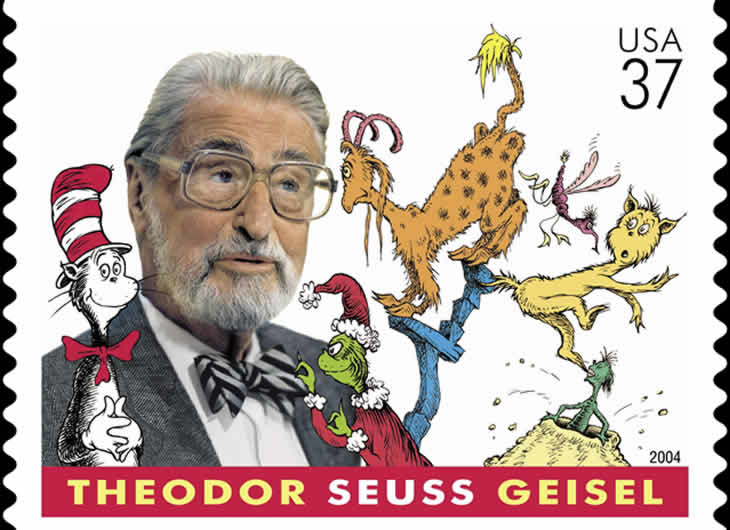
On Month Three and Day Two, what a surprisal! The first day on Earth for Theodor Seuss Geisel! ‘Twas 111 years ago (no less or more) when he was born on March 2, of 1904. He began life in Springfield. (The state? Massachusetts!) His name became famous, instead of a “Whozits?” He signed college art “Seuss”…to hide his true name. (He’d been caught drinking gin – in those days quite a shame!)
He traveled to England, to learn English lit. But advice from Helen Palmer caused him to quit. He went back to drawing, his English hopes buried. With success in New York, he and Helen were married. He drew advertisements, and the money was fine. But his life’s truest calling was still down the line. In 1936 (with a Europe trip planned) he took a sea voyage, with time on his hands. The book that he wrote there would prove rather neat: “And to Think That I Saw it on Mulberry Street.” It was based on a real street in his New England hometown. The sales were so-so, but he would soon find renown. Have I left something out? Is my memory loose? Oh yes! This was the first book he signed “Dr. Seuss.”
Then came World War II, and Geisel stayed busy…with political cartoons. (Politics?? Are you dizzy?!) He stood against Hitler, and took his stance firm. (Even old Charles Lindbergh couldn’t cause him to squirm.) He joined up with the Army, and made films for the war…and after we’d whipped ‘em, turned to kids’ books once more.
“The Cat in the Hat.” “If I Ran the Zoo.” “Green Eggs and Ham.” “Horton Hears a Who.” He wrote ‘em and drew ‘em, a famous one-two. (The “Cat” book taught reading, but the kids never knew.) He wrote more than 60, and sold a whole CLEFTUS!* Then in 1991, he laid down and left us.
His art and his writing, folks haven’t forgotten. As long as kids read, they’ll stay fresh (and not rotten). One lesson he stood on: To yourself be true. (No matter the cost, only you can be you.) It’s a lesson quite fitting, for this part’s the truth-iest: Out of all of the Seusses, Dr. Seuss was the Seuss-iest.
* 1 cleftus = 14 hoodzinks (or about 600 million copies)
http://www.davidpaulkirkpatrick.com/wp-content/uploads/2013/07/Dr.-Seuss_US_stamp.jpg

Sunday, March 1, 2015

The AWC train is pulling into the station, with one more week of anniversaries worth celebrating. On this date 54 years ago, John F. Kennedy established the Peace Corps with an executive order on March 1, 1961. It fulfilled a goal he had expressed as a member of Congress a decade earlier, and campaigned on during his run for president in 1960.
The idea was to send recent college graduates into the developing world, helping locals learn basic skills of self-sufficiency and rebutting negative stereotypes of Americans as imperialists. Kennedy’s vision of the Peace Corps as an engine of cultural exchange and international cooperation was also found in his inaugural address. His famous line to Americans – “Ask not what your country can do for you, ask what you can do for your country” was followed by this remark addressed to all world citizens: “Ask not what America will do for you, but what together we can do for the freedom of man.”
From an honest perspective, the Peace Corps can be seen as a way to address the world’s problems on the cheap. It costs the country relatively little to send young volunteers into villages. (On the flip side, these emissaries have relatively little experience and training, as some critics of the Peace Corps have noted.) The Peace Corps’ 2014 budget of $379 million might sound like a lot, but in truth it represented about 1% of 1% of the government’s annual budget. The Peace Corps hasn’t ended any world problems with that level of resources, but they have contributed efforts to fight malaria in Africa, and assist with health, education, and nutrition efforts worldwide.
In the end, the Peace Corps represents a vision of what the world could be. (This could be seen as covering for a lack of concrete results, and critics have charged the organization with exporting “emotionalism” above all.) Maybe the most important question to ask is whether we’re a better country with a Peace Corps than without one. An author of a critical report about the organization in 1986 concluded "The Peace Corps is the epitome of Kennedy's Camelot mythology. It is a tall order to expect a small program appended to an immense superpower, to make a difference, but it is a goal worth striving for."
http://s.hswstatic.com/gif/peace-corps-9.jpg